
Our latest industry data reveals what a healthy website traffic mix looks like for estate agencies, and how AI is already starting to reshape it.
Website traffic mix for estate agents
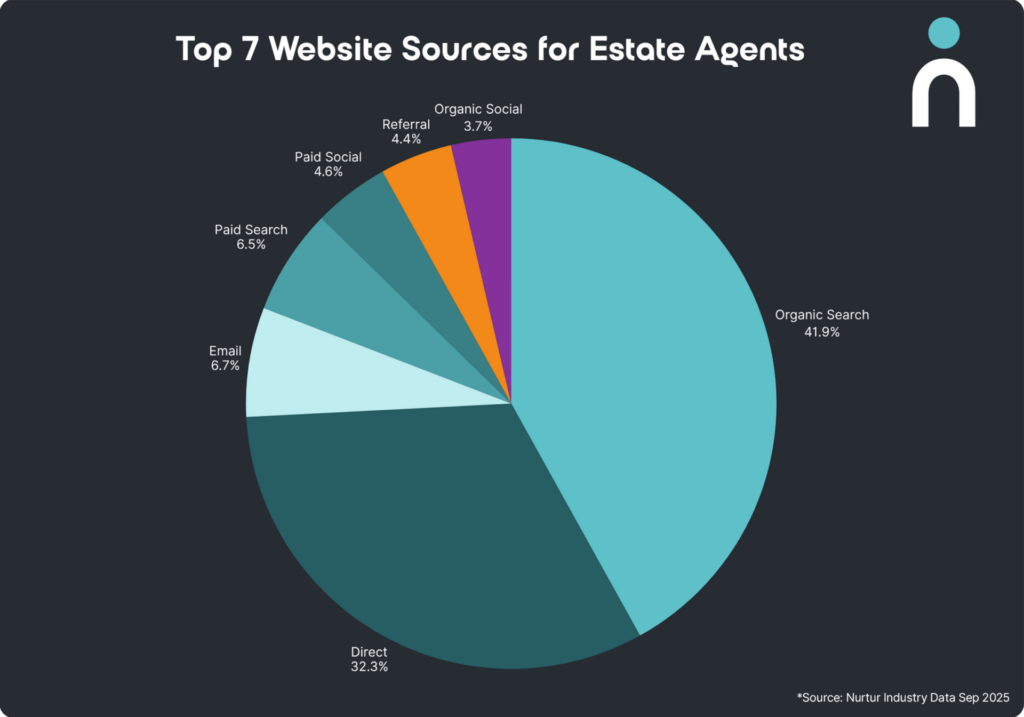
This is what website traffic for estate agents looked like in 2025 when having a strong marketing strategy in place:
- Organic Search: 39%
- Direct: 30%
- Email: 6.2%
- Paid Search: 6.0%
- Paid Social:4.3%
- Referral: 4.1%
- Organic Social: 3.4%
*Nurtur Industry Data, Sep 2025
This data reflects a mature, diversified marketing strategy, blending multiple channels such as paid search, paid social, organic, email, and direct marketing.

For now: Organic as number 1 traffic source
It’s important to note that organic traffic is often driven by awareness content, for example, blog posts or searches like “estate agents in my area”. Direct traffic, by contrast, relies on brand awareness and familiarity, meaning that paid activity, social media, and email marketing play a vital role in keeping agents top of mind.
However, this traffic mix is already being disrupted by a new and fast-emerging source of traffic: AI referrals.
The AI shift has begun
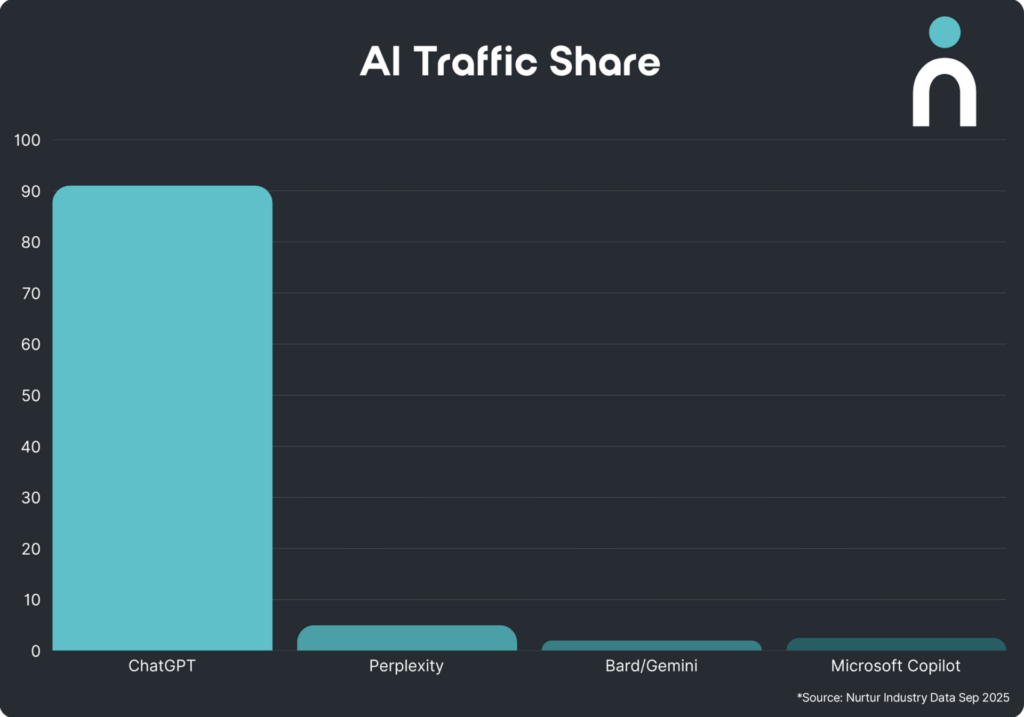
Current data could indicate that traffic generated from AI-powered platforms such as ChatGPT, Gemini, and Perplexity will grow sharply from 0.05% in early 2025 to more than 40% by mid-2028 for estate agency websites, considering the immense increase seen over the past 12 months.
At present, AI traffic represents just 0.2% of total visits, yet this reflects a year-on-year growth of 1,784%. However, the challenge with AI searches is that people no longer need to visit websites for awareness-stage content.
This growth therefore won’t necessarily result in more overall visits. In fact, organic search traffic could fall by as much as half, according to Gartner — a trend likely to be mirrored in the property industry.
This pattern isn’t entirely new. Google’s preview boxes have long reduced click-throughs by answering queries directly in search results, a shift now accelerating with AI Overviews.
A recent study reinforced this: Ahrefs reported a 34.5% lower average clickthrough rate.
However, the property sector has so far remained resilient, with organic traffic holding steady at 39% year-on-year, with an overall higher traffic level.
How AI will affect conversion
“We can see that AI-driven visitors are likely to convert at far higher rates than traditional search traffic because they arrive ready to take action,” said Richard Combellack, Chief Commercial Officer at Nurtur.“AI traffic already shows a 12% conversion rate across the board,” he added, referring to data from estate agency websites within the Nurtur network.
“The challenge is visibility,” he continued. “Agents must ensure their brand, listings, and content are being understood and surfaced by AI systems, not just Google.”
Seeing Through the AI Black Box
While AI offers opportunities for higher-intent traffic, it also creates a ‘black box’ in the marketing journey, where the steps leading up to a website visit are invisible to traditional analytics.
This makes it even more critical for agents to:
- Optimise website content for AI discovery and summarisation
- Build content that answers the questions audiences are already asking
- Strengthen reputation signals such as reviews and local authority mentions
- Use integrated data and marketing systems to track and convert leads consistently
What does this mean for the future
As AI reshapes search and consumer behaviour, Combellack predicts that the most successful estate agents will be those who combine strong traditional marketing with a forward-thinking digital strategy.
“The future of lead generation won’t be about who ranks highest,” Combellack added. “It’ll be about who’s recognised and recommended by the tools home movers trust most.”